
DMX in Practice
The first picture shows the rear of a typical DMX controlled light or other equipment together with the ends of a DMX cable that would join it to the next or previous device. The item on the right is a terminator.
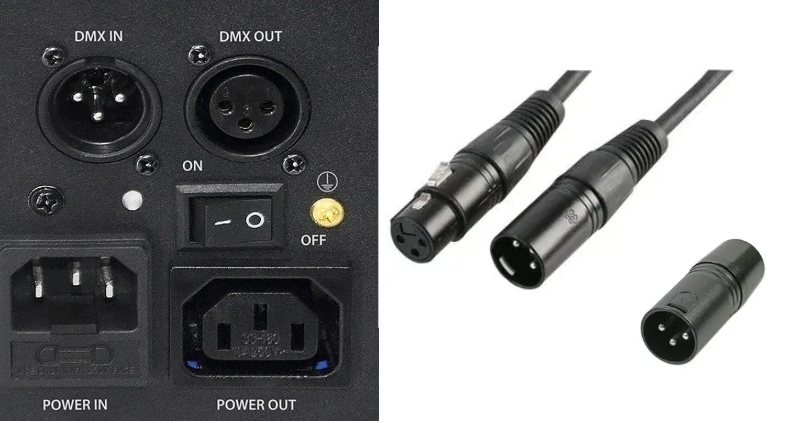
The wiring for DMX lighting must be daisy-chained like this.
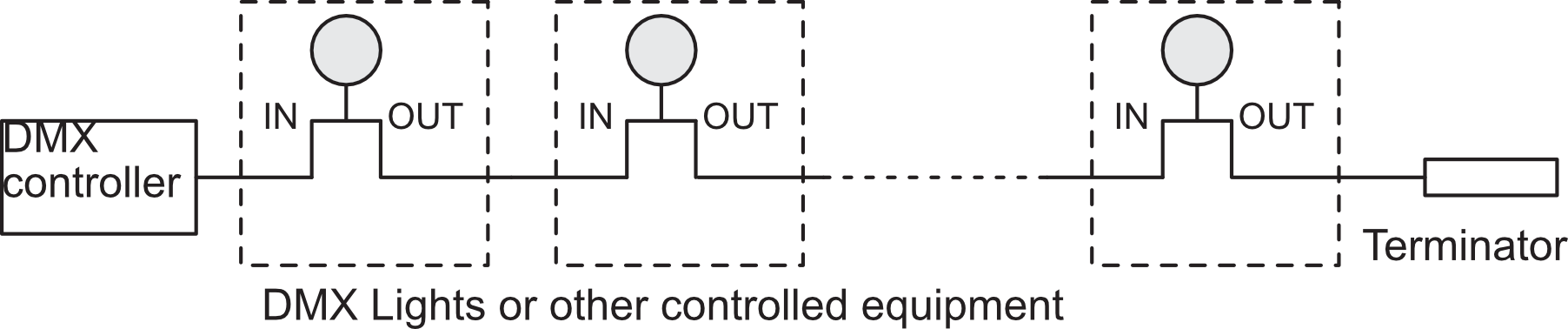
Note that, despite the labels, there is no electrical difference between DMX-IN and DMX-OUT, they are connected together internally. The different connector genders ensure that there is no chance of accidentally mixing up the signal wires or looping the wiring. All the devices get the same signal at the same time - electrically they are in parallel even if the appearance is of a serial connection. The DMX start addresses have no relationship to the physical set up. For example in the picture above, working from left to right the addresses could be 124, 13...199. Of course, putting them in some sort of order makes organization a bit easier!
DMX lights have at least three connections; one for mains power, one for DMX-IN and one for DMX-OUT. The last item on the chain is fitted with a terminating resistor to provide an electrical load. It is also common to have a power out socket so that mains power can be daisy chained too.
The example picture shows 3 pin DMX connectors. Originally DMX had 5 pin connectors but as two of the pins were never used, the 3 pin version has become the norm. Unfortunately this makes DMX cable look exactly like microphone cable - which will often work over short distances. On longer distances the different impedance of microphone cable (which only needs to handle audio frequencies) degrades the DMX signal and can cause problems that are hard to track down.
On some upmarket DMX equipment, both 3 pin and 5 pin connections are provided. Either can be used.
The requirement to have a single daisy chain for the lights causes a problem where the equipment layout would be simpler with one or more branches. In this case a powered splitter is required. It does not need a DMX address of its own because it reads all 512 channels and re-transmits them on new segments of DMX cable.
The maximum allowable length of a DMX segment is 300m and the maximum number of devices is 32. Neither of these limits is a problem for us.