
DMX Theory
The lighting computer running Magic Q software sends its output to a Chamsys "PC Wing" using USB. The wing converts this to two sets of DMX controls. DMX (short for DMX512) calls each of these a "universe" which can provide up 512 numeric instructions called channels The values in a channel are between 0 and 255.
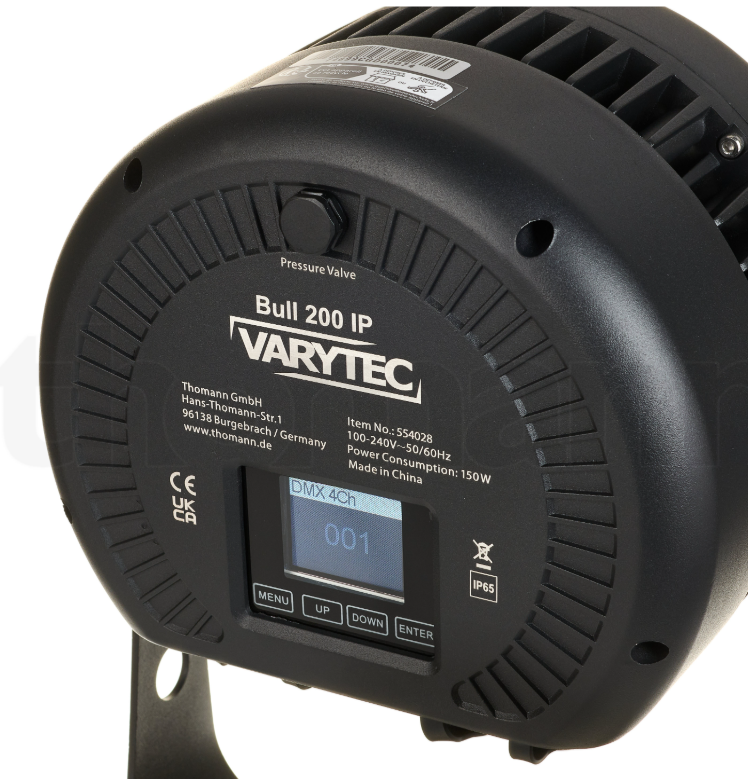
All the lights in a universe receive all the channels at the same time and have to pick out the channels relevant to them. They do this according to their "start address". This is set on each light. For example in the light below we can see that the start address has been set to 001 using the up down buttons. DMX units store their address permanently so once set it is not necessary to do it again. In this example we can see that the light uses 4 channels, i.e. channels 1,2,3,4 because the start address is 1.
Consider a lamp with a starting address of 5 using 3 control channels.
If the 512 channels sent by the computer started with these values:
100 3 47 255 255 0 77 89 78 42 ....
then the light with would pick out 255, 0, 77 as its instruction.
There is no rule about which lights have which address or what the individual channels mean. How a light responds to its channel values and how many channels are needed is determined by its 'personality'. Magic Q has a huge (and ever expanding) library of these so that the user just sets what they want to get from the light - say yellow at 40% brightness - and Magic Q takes care of what channel values need to be sent.
Note however that most of our lights (legacy lights) are incandescent and can be remotely controlled only in brightness and this is done by reducing their mains voltage. Only a single DMX channel is therefore needed for each light and this has to be routed to intermediate conversion equipment (see the legacy lighting page for details). Magic Q provides a 'Generic Dimmer' personality for this type of light.
DMX is a one way system*, there is no reply from the lights and no error indication. One easy error is to set overlapping addresses. The light in the example above needs 3 channels starting at address 5. If another light was set to address 6, it would respond to values starting at the sixth channel, even though that value was intended for the other light. The nearest unused address in this case would be 8.
Although it is usual to set start addresses as close as possible, there is no requirement to do so. For example, multiple 3 channel lamps could have starting addresses of 30, 40, 50 etc.. In this case channels 30, 31, 32, 41, 42, 43, 50, 51, 52 would have values in them and the intermediate channels would be set to zero. (unless other lamps were patched in the gaps).
* RDM (Remote Device Management) is a modern development of DMX that allows lights to communicate with the controlling computer by squeezing messages between each set of control signals (the DMX frame). We don't have any lights with this functionality.