Legacy Lighting
Prior to the use of DMX, all our lights were incandescent and we still have many of these. The only live control possible is dimming them by reducing their individual mains voltage. Every other control (direction, colour, focus etc.) is limited to manual settings in advance of a production.
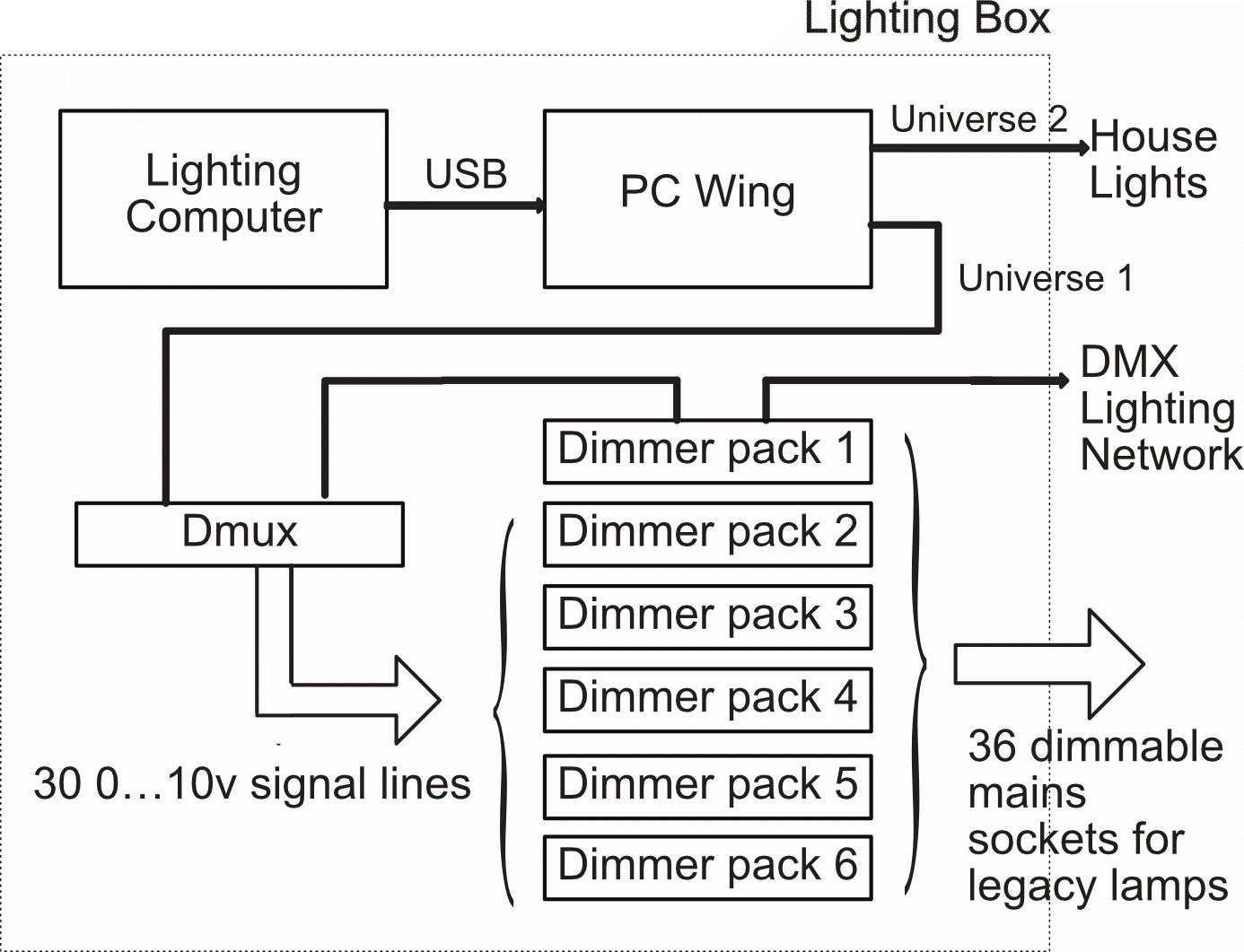
The earlier control desk sent analogue signals to "dimmer packs" housed at the left end of the lighting box and these are still in use:
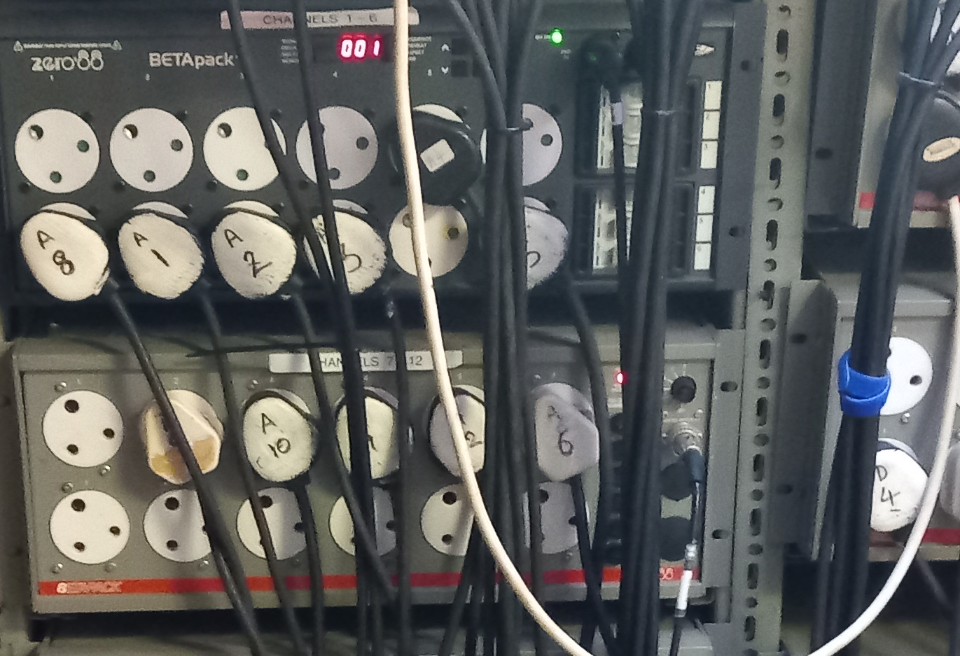
Each of the dimmer pack outputs has two sockets, one above the other to make it easy to run two lights from the same source, i.e. both light's brightness will go up and down together.
The plugs are 16Amp round 3 pin types. Although obsolete in domestic wiring, they are common in theatres because they do not contain a fuse. In theatre wiring, it is common to have temporary extension leads where it would often be difficult to locate or access a blown fuse. Instead, there is only one fuse or circuit breaker per channel located on the right hand end of the dimmer pack itself.
Each plug is labelled with its corresponding socket number. For example, we can see that channel 9 has plug A10 inserted. The other end of this cable ends up at socket at A10 - the tenth socket on lighting bar A. Any legacy lamp could be plugged into that socket, depending on the requirements of the show
Dimmer pack1 is different to the other five because it responds to DMX rather than analogue signals. We can see that its DMX start address is set to 001 (the red LED figures).
For DMX to control the legacy lights, a "Demultiplexor" or Dmux is used to create the 0-10V analogue signals from the 0-255 values of DMX channels 7 to 42.: