
Sound and Projection Circuits
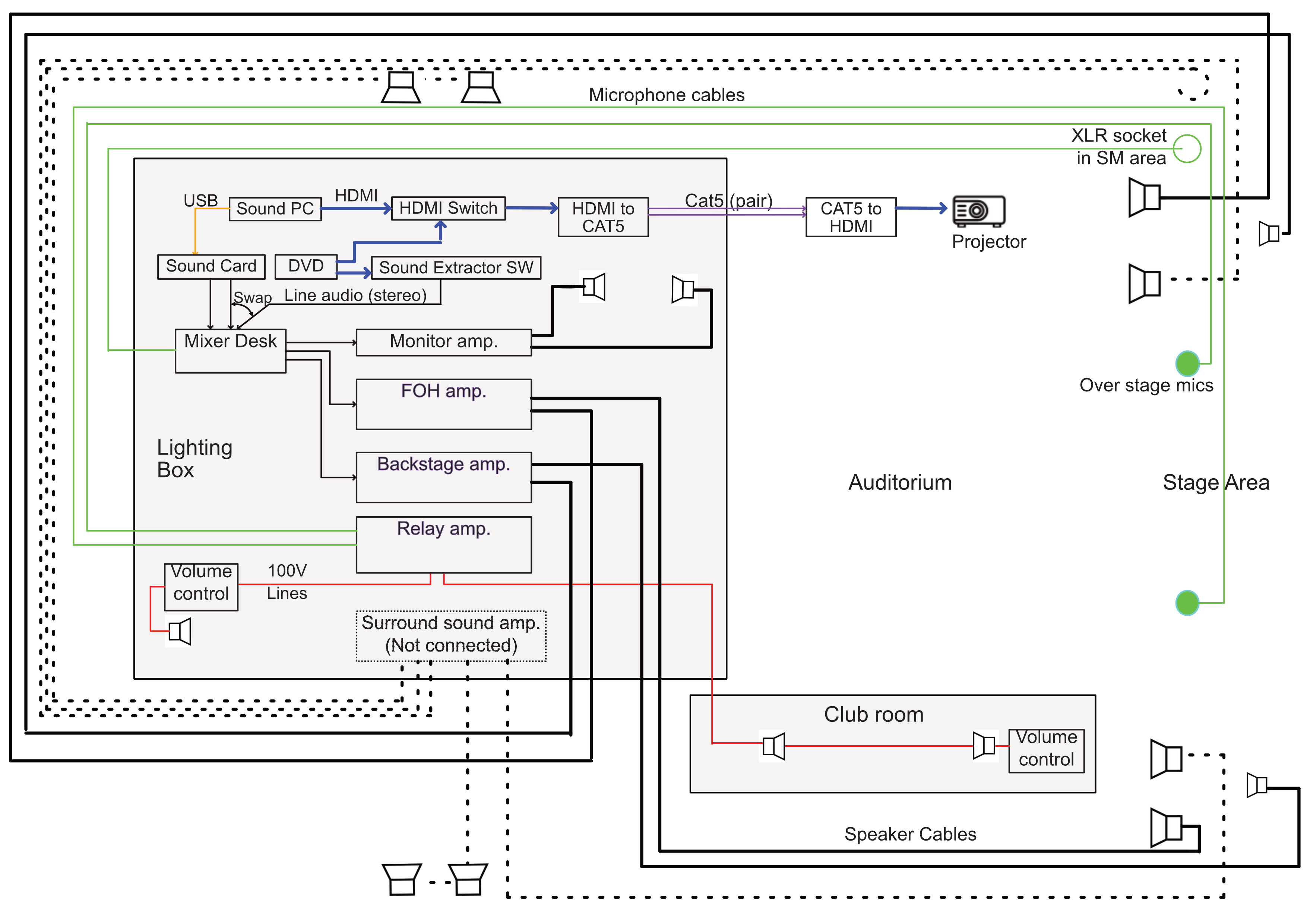
The diagram below shows the currrent (March 2025) arrangements. You can click the image to download a bigger version.
Projector connections
The way the projector is driven depends on whether the signal starts with the sound PC or the DVD playing Blu-Ray discs.
The sound PC has two outputs, the HDMI cable that is used for video from the SCS software and a USB cable connected to an external sound card with two stereo outputs. The stereo outputs usually feed the 'MIX' and 'SUB' inputs of the mixer desk
The DVD player has two HDMI outputs - one with combined video and sound, one with video only. The video only HDMI goes to a switch to choose if it or the sound computer HDMI should be passed on to the HDMI to cat5 converter. The converter is needed because the projector is too far away from the lighting box to use HDMI all the way. The resulting ethernet signals are converted back to HDMI before they reach the projector.
The sound part of the HDMI from the DVD player is extracted by the HDMI extraction unit but there is no equivalent to the HDMI switch used for video. Instead the signal from the sound card is unplugged from the SUB' input of the mixer desk and replaced by that from the DVD when films are being shown. The various components are shown below.
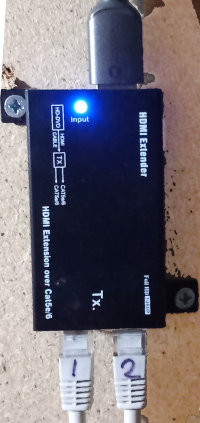
HDMI to cat 5 Transmitter under the workbench. Receiver, located on the unistruts near the projector, is similar
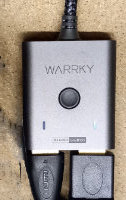
HDMI switch, under the DVD player. The round button is the switch.
Left LED = SCS
Right LED = DVD player
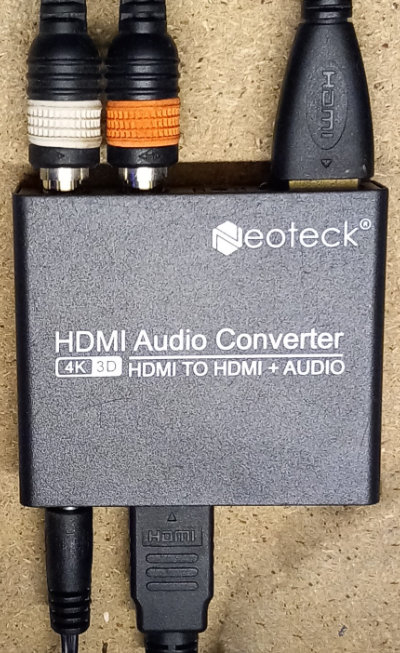
Audio Extractor. Loose on the workbench, maybe under the mixer desk
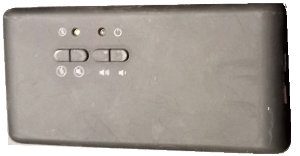
Sound card - loose in the metal cabinet.
Sound monitor
The mixer desk allows the user to monitor the different sound channels, even if their faders are fully down.The components involved are:
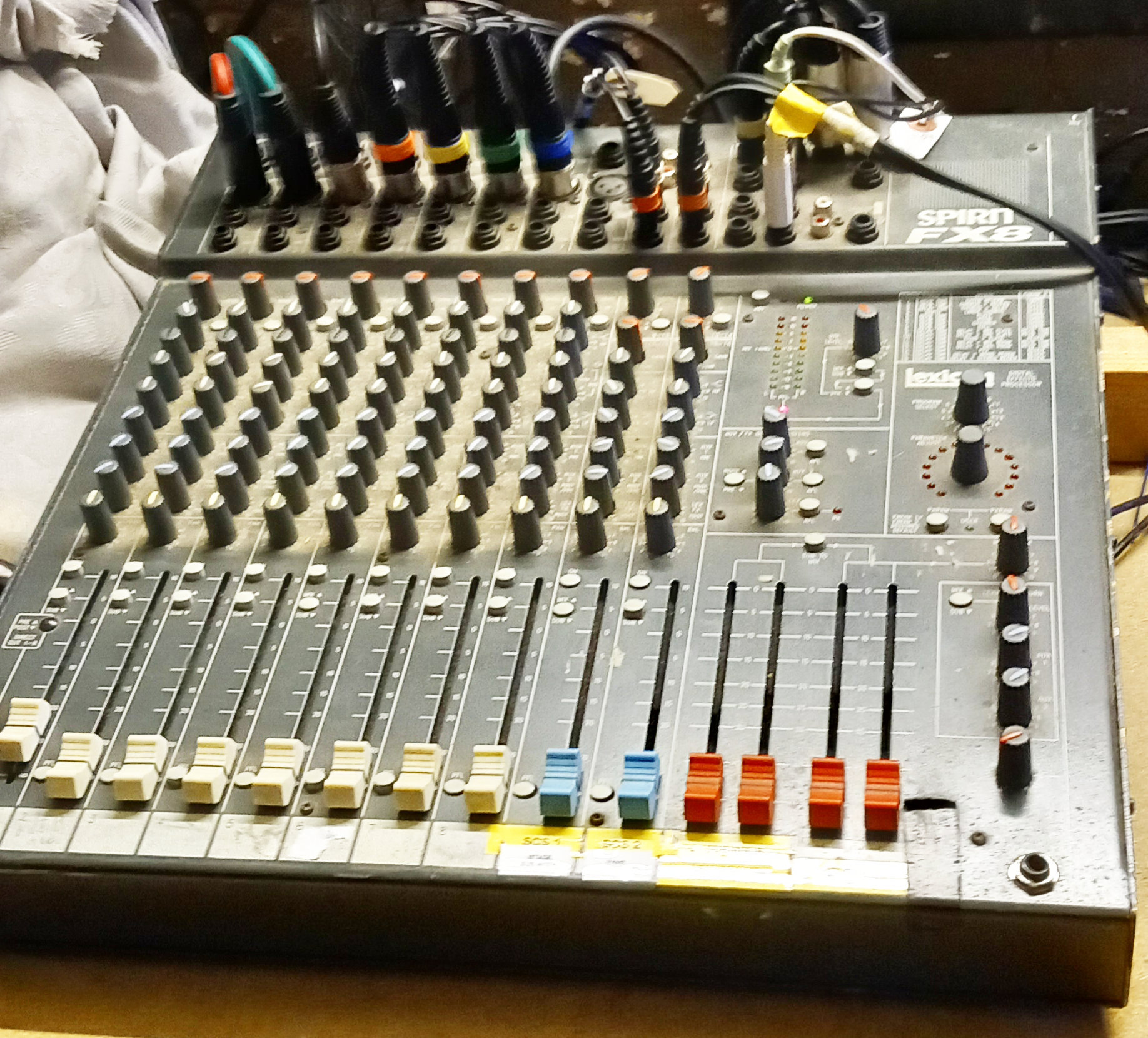
Mixer desk.
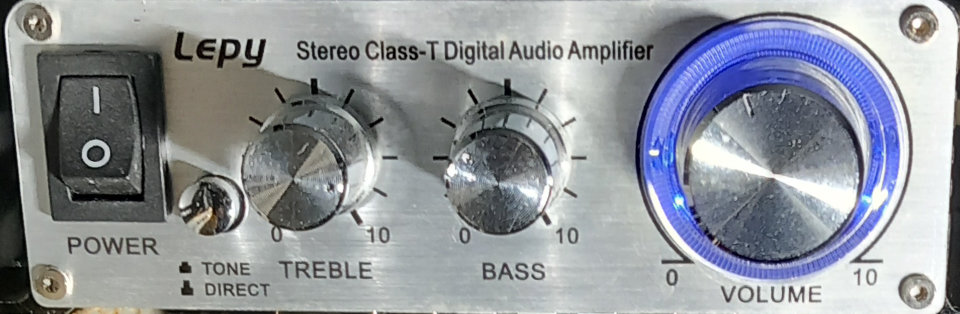
Monitor amp, loose in the metal cabinet.

Monitor speakers
FOH (Front of House) sound
The front of house speakers are the large speakers to the left and right of the stage they are the main speakers used at the theatre. They are driven from the mixer desk via the M-2600 amplifier. The yellow labels on this are out of date and should be ignored.
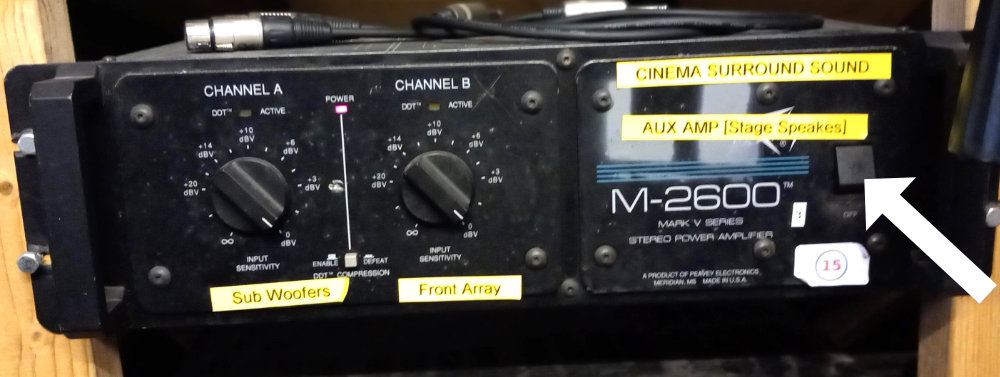
M-2600 main amplifier.
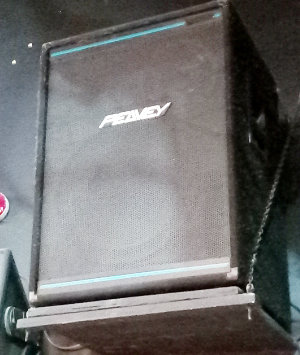
Main Speaker
Backstage sound
The backstage amplifier takes its signals from the mixer desk and feeds the small backstage speakers mounted near the stage entrance doors. They are mostly used when the sound effects need to come from the rear of the stage or when actors need backing music.
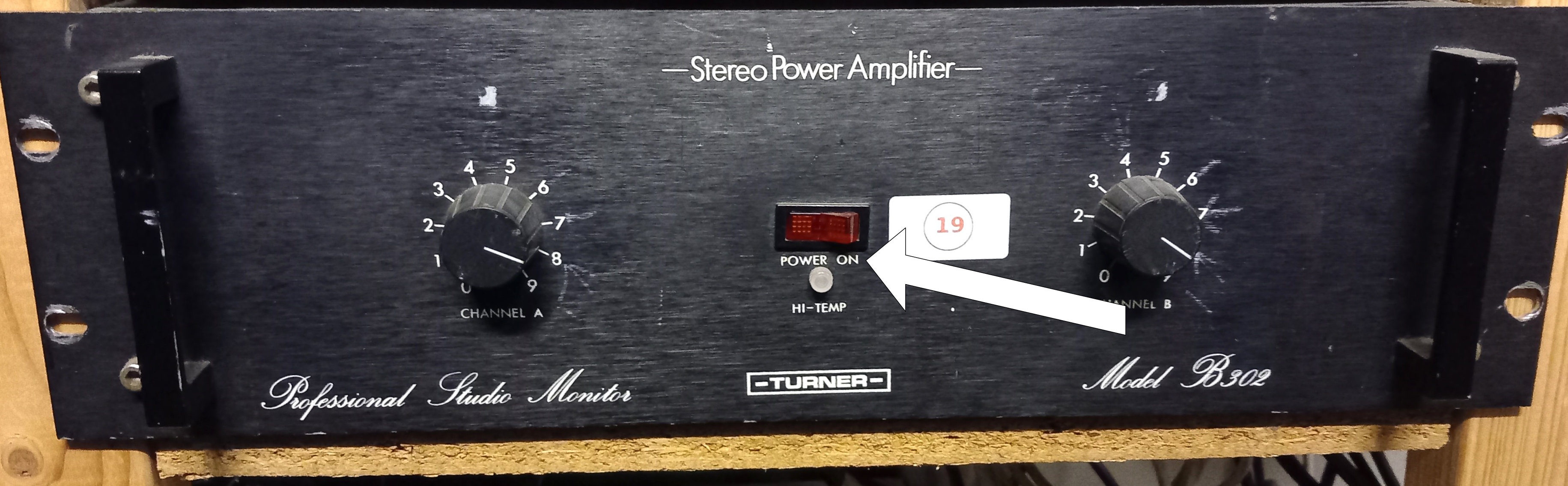
Backstage amplifier
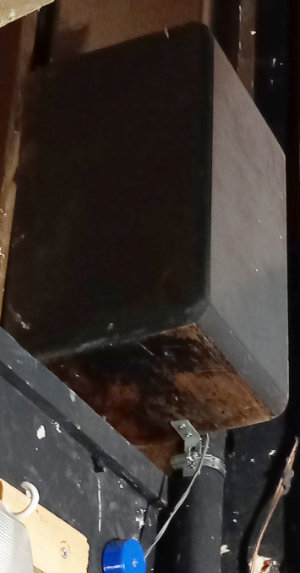
Backstage speaker
Stage Relay
The stage relay uses two small microphones hanging behind the red skyborder above the stage. These are not used for stereo but are spaced apart to give good general coverage.
Their signals are mixed and amplified by the relay amp. for the 100 volt line to the clubroom. This is used so that the actors waiting there for their entrances can hear where the play has got to. The volume of the speakers at ends of the clubroom is adjusted be a small control mounted underneath the speaker at the east end of the clubroom.
A second output from the amplifier feeds the same type of speaker and volume control in the lighting box. This can be useful when actors are not speaking loudly enough for the the lighting or sound cues to be heard clearly.
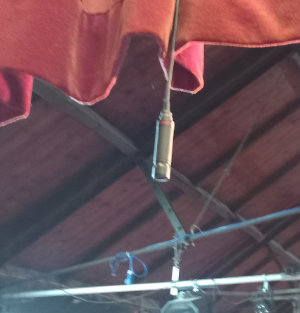
Over stage mic
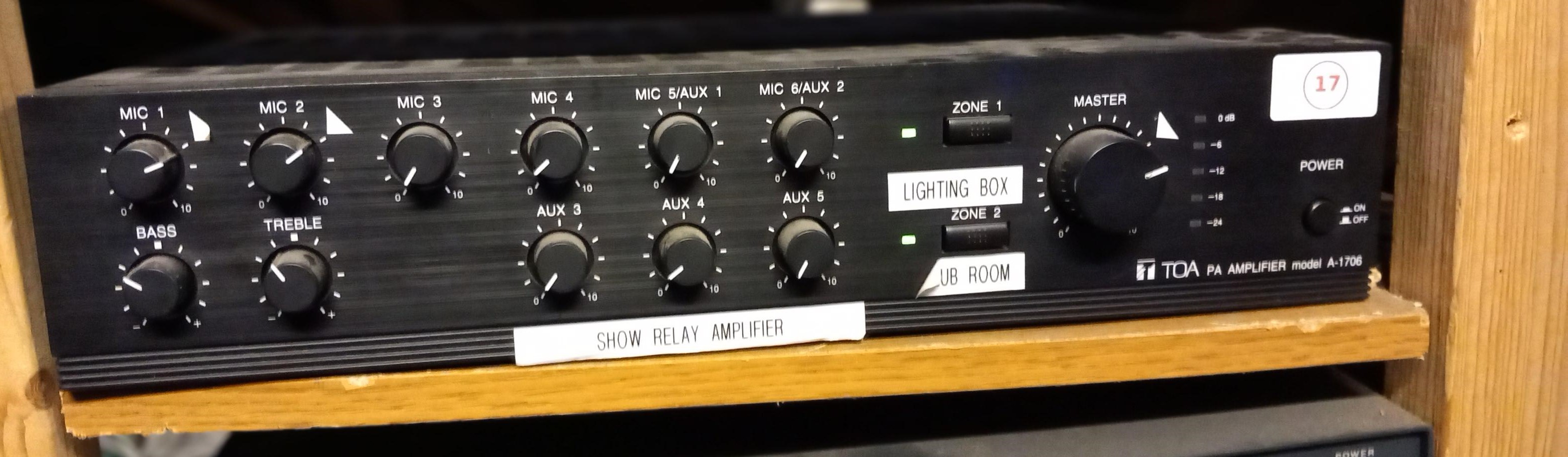
Relay amplifier.
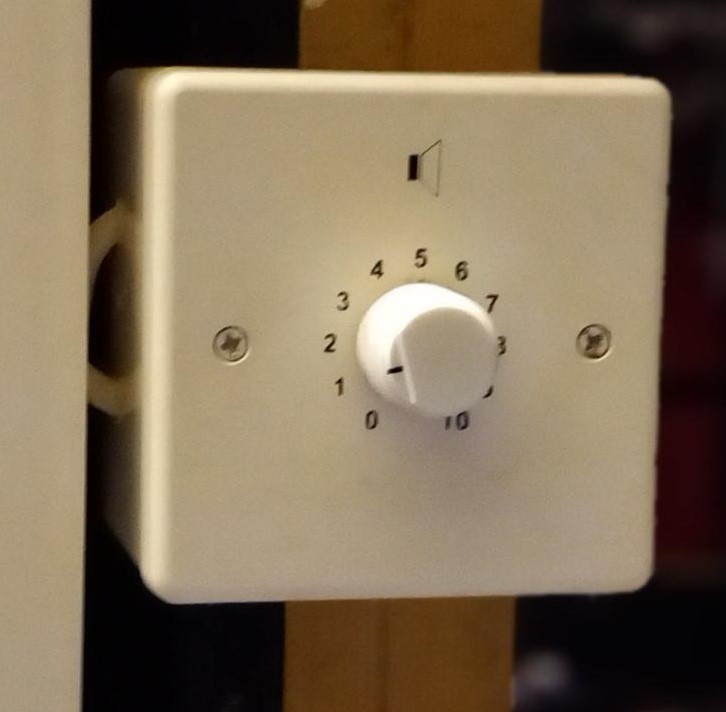 Volume control
 Relay speaker
Remote sound input
There is a 3pin XLR socket in the stage manager's area wired back to the lighting box. This can accept a wired mic or any equivalent input. Sometimes the theatre is hired by groups who want to provide their own sound from a laptop or similar in the SM's area rather than from the lighting box. Provided they have a suitable convertor, this provides an easy solution
Surround Sound System
The surround sound system is not operational. It is included here because some of the components are still in place (May 2025) and it may be resurrected in the future. In the diagram, the components are shown dotted.
The source would be a Blu-Ray player, possibly the one currently used for films with a 7.1 surround sound digital output. 7.1 means 7 speakers (left front, centre front, right front, left side, right-side, left-back, right back) and a single sub-woofer (the .1).
The Pioneer VSX-2011 receives the digital data from the player and amplifies the 7 channels. The subwoofer has to be driven separately and is not mounted although there there is a cable for it that ends near stage-right.
There are six surround sound speakers mounted around the auditorium but those on the sides of the auditorium are wired in parallel - i.e. as it stands, there would only be 4 independent sources of sound.
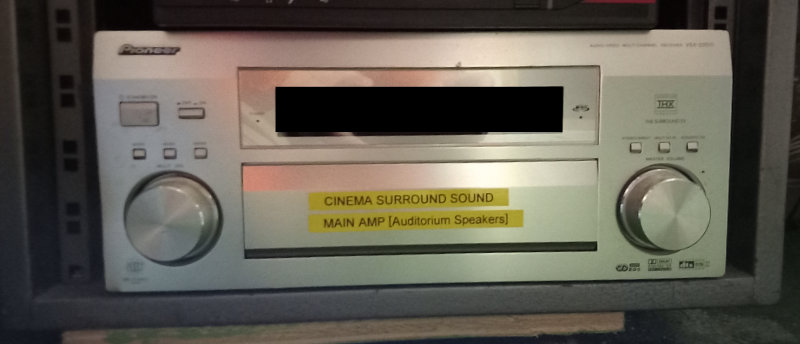
Pioneer VSX-D2011 Surround sound receiver
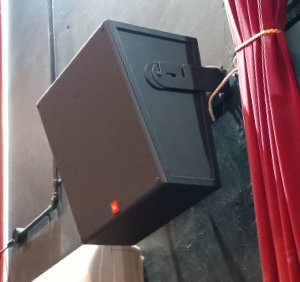
Surround sound speaker